
Reuse and materials
How to measure cardboard thickness and choose the right board
Identify solid, single-wall and double-wall cardboard, measure it without crushing the flutes, and match the thickness to your DIY template.

Measure the board before you cut. The thickness affects how wide a slot needs to be, how a fold closes and how much space is left between panels. Start by looking at a clean cut edge.
Read the edge
- Solid paperboard has no waves. A cereal box is a good place to look for thin card for trim, brick facings and small folds.
- Single-wall corrugated board has one wavy layer between two flat liners. Check small delivery cartons for the roughly 2–3 mm board used in many miniature projects.
- Double-wall corrugated board has two wavy layers and three flat liners. Look in heavy shipping cartons for larger panels and projects that call for thicker stock.
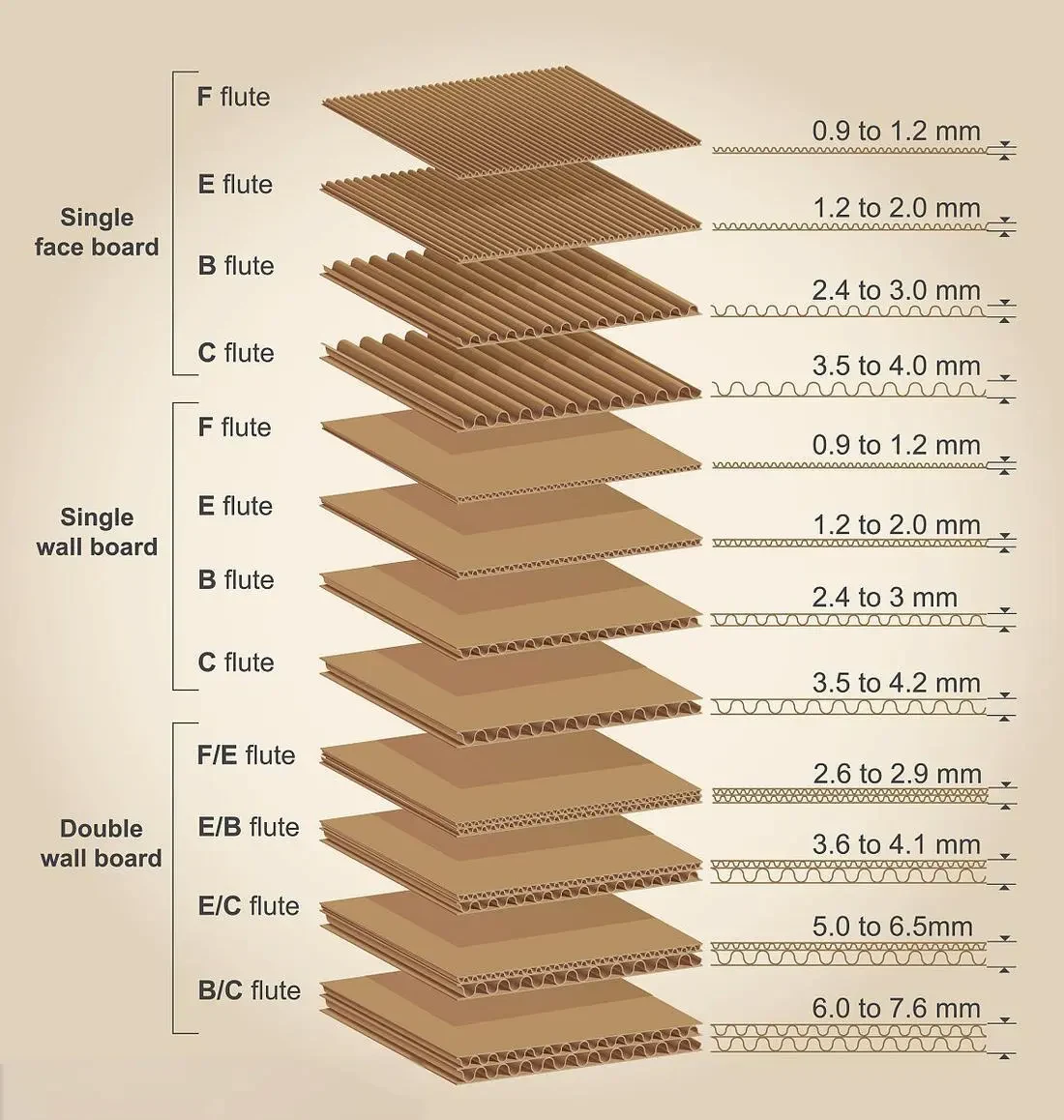
Flute letters describe the shape of the wavy layer. For single-wall stock, the chart gives typical ranges of 0.9–1.2 mm for F, 1.2–2 mm for E, 2.4–3 mm for B, and 3.5–4.2 mm for C. These ranges are for sourcing. A template label gives the exact thickness it was drawn for. Manufacturers’ ranges vary, so check the box and measure the sheet itself. In a double-wall grade such as BC, the letters refer to its two flute profiles. Sandland Packaging board ranges · FEFCO flute profiles
Measure without crushing the flutes
- Choose a clean, flat panel away from tape, seams, folds, dents and water marks.
- Zero your calipers. Close the jaws lightly across both outside faces, stopping as soon as they touch. For thin solid card marked in points, 1 pt is 0.0254 mm, so 20 pt is about 0.51 mm. Custom Product Packaging’s thickness overview
- Measure at least three spots and write down the range. Check the direction of the flutes and mark it on the board before laying out parts.
- Use the template for the measured thickness. Test a slot or score a fold on an offcut from the same panel. A fold should close square and keep its outside liner intact. A glued tab should sit flat against the receiving face.
Match the board to the build
Colodaily starts with single-wall board for structural parts. F and E flute are useful starting points for small panels and tight folds. B and C flute are candidates for larger walls and bases. Use solid card for shallow surface details such as the brick facing. Board condition, flute direction, panel span and joint fit all affect how the finished build holds up.
Glue removes the need for a slot to grip the board. Thickness still matters where panels overlap or meet at a fold. The Retro TV Cat Hideout has A2 profiles for measured stock of 2.5, 3, 3.5 or 4 mm. Each profile adjusts how the side panels fit between the front and back and where the roof flaps land.