
House projects
How to make a cardboard gingerbread tower house
Build a tall, narrow gingerbread house from shipping-box board, with a round gable window, an arched door and a lift-off roof for a battery tealight.
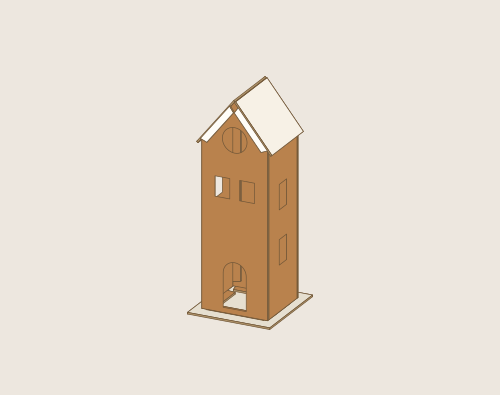


A gingerbread house does not have to be wide. This one stands tall and narrow, like a townhouse on a winter street, and its windows glow when a battery tealight sits inside. The right half of the roof lifts off, so you can switch the light on and off without taking anything apart.
Use a battery LED tealight only. Never put a real candle in a cardboard house.
Prepare your materials and tools
Start with clean, dry packaging you already have. A wavy layer at the cut edge means corrugated cardboard. A thin, solid edge means paperboard.
Cardboard boxes to look for
 Amazon or delivery box
Use a flat side away from tape, old folds, and crushed corners.
 Coke or Pepsi multipack
Look for a flat, solid edge. Use a large panel clear of handle holes.
 Cereal box
Try the broad front or back panel. Measure away from the glued seam.
 Clean pizza box
Check the lid for one wavy layer and matching thickness. Use an area free of grease and moisture.
Tools to put on the workbench
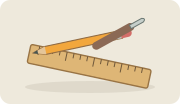 Pencil, ruler and blunt scorer
Trace the pattern and mark fold lines. Use calipers to check board thickness.
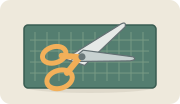 Scissors
Cut paper patterns, stickers and thin paperboard.
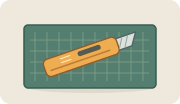 Craft knife, metal ruler and mat
Use light passes for stiff cardboard. An adult can handle the knife when children help.
 White PVA glue
Spread a thin coat on a flap. Test the bond on an offcut and hold the joint while it sets.
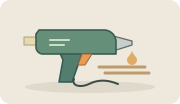 Low-temperature glue gun
Optional for thicker cardboard. An adult can test a thin bead on scrap and check that the joint still sits flat.
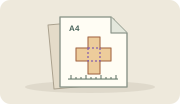
Prepare for Gingerbread Tower House
A4 templates Use 210 × 297 mm paper. Print at 100% actual size and check the 100 mm scale on the sheet before tracing.
Use 2 mm single-wall corrugated cardboard. Select the matching board thickness in Studio.
Open the box along its taped seam and check that the largest pattern fits on a flat panel. Measure away from crushed edges and old folds. Cut a scrap first to test your blade, fold, and glue.
Prepare the board
Use clean, flat single-wall corrugated board about 2 mm thick. The two gables are the tallest pieces, so look for a shipping or appliance box with an unbroken panel at least 80 × 265 mm. Keep the flutes running up and down the walls; that keeps the tall gables stiff.
Build it
- Check the print. Measure both 100 mm rulers on sheet 1 before you cut anything.
- Cut the openings first, then the outlines. The round window, the door arch and the small windows are easiest to cut while the board is still large and steady.
- Stand the two gables on the base, gluing the foot flaps. Check that they stand square and parallel.
- Fit the side walls between the gables, coating the foot and both end flaps.
- Glue the left roof onto the gables with its end flaps.
- Rest the roof lid on the right slopes, tucked under the left roof at the ridge. Do not glue it.
Decorate
Paint or sticker the icing after the glue has dried: a white edge along the roof, frames around the windows, a heart above the door. Keep stickers clear of the lid’s ridge edge so it still lifts off.