Prepare materials and tools
 Reused boxLook for clean, dry 0.5 mm solid paperboard.
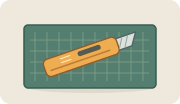 Craft knife & matUse a mat under the board while cutting.
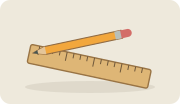 Pencil & rulerTrace the patterns and use a ruler to guide the straight cuts.
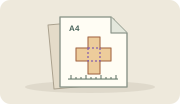 A4 templatesPrint at 100% and check the 100 mm ruler before tracing.
Check the cut edge. Look for a thin, solid edge with no wavy layer. The whole blank needs a flat area of 50 × 60 mm. Check the board →
Choose your board and open the A4 templates ↓Materials and A4 templates
Print at 100% / Actual size and check that the printed ruler measures 100 mm.
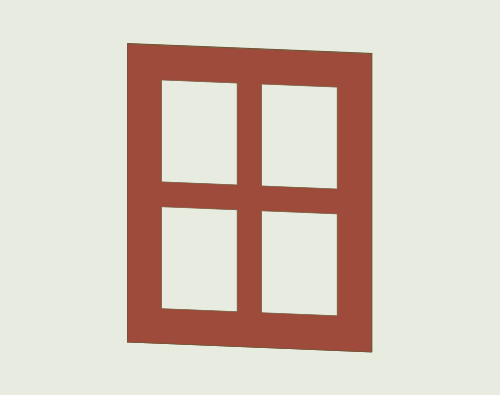
Trace the four inside rectangles and the outside edge. Keep the border and crossbars connected.
One cut piece
W1 is the whole frame. Cut out all four pane openings. Use the A4 sheets to trace at actual size.
W1
Part details
Technical drawings
Arrows show dimensions in millimeters. Coordinates in the tables start at the lower-left corner of the cut blank. Use the A4 templates for actual-size tracing.
Frame · W1
Solid brown · cutDashed purple · score and fold
- Cut around the solid outer outline.
- Cut out the pane opening (15.5 × 20.5 mm).
Exact coordinates and edge lengths
Measure from the lower-left corner of the blank. X runs right and Y runs up. The tables have their own row numbers. Join the outer edges in order.
| Mark | Feature | X, Y in mm | Dimensions in mm |
|---|---|---|---|
| 1 | Pane opening | 7, 7 · Lower-left corner | Width 15.5 · Height 20.5 |
| 2 | Pane opening | 7, 32.5 · Lower-left corner | Width 15.5 · Height 20.5 |
| 3 | Pane opening | 27.5, 7 · Lower-left corner | Width 15.5 · Height 20.5 |
| 4 | Pane opening | 27.5, 32.5 · Lower-left corner | Width 15.5 · Height 20.5 |
| Edge | From X, Y | To X, Y | mm |
|---|---|---|---|
| 1 | 0, 0 | 50, 0 | 50 |
| 2 | 50, 0 | 50, 60 | 60 |
| 3 | 50, 60 | 0, 60 | 50 |
| 4 | 0, 60 | 0, 0 | 60 |
Cut the window frame
Read through the steps here, or rotate the exploded model and follow the build in Studio ↗.
1. Trace and cut the outer frame
Trace W1, including its four pane openings, onto flat paperboard. Cut around the outside rectangle first.
View in Studio ↗2. Cut out the four panes
Use a craft knife and ruler to cut the four inside rectangles. Lift out the scraps and keep the border and crossbars in one piece.
View in Studio ↗Connection spec for project designers
Reserve a flat 50 × 60 mm area on the outside of the wall. The project supplies a centered 38 × 48 mm through-opening and a 6 mm contact band around it.
The rear border of the frame is the glue surface. Keep the four panes and the wall opening clear.
Test an inside cut on a scrap of your board before cutting the frame.